AI
1 days agoNews Editor

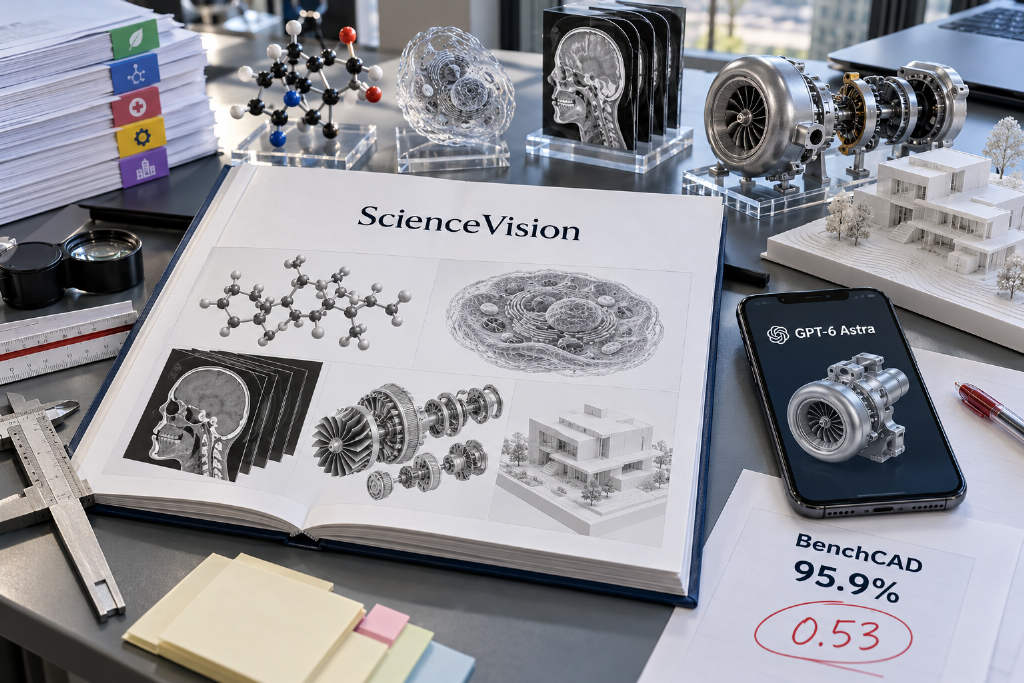
ScienceVision benchmark puts GPT-6 Astra’s 3D scientific reasoning score at 0.53 despite a 95.9% BenchCAD result

A new benchmark called ScienceVision is challenging the idea that strong CAD demos translate into real 3D scientific understanding. The system, developed by UniPat AI and visual reasoning lab Elorian AI, spans biology, chemistry, medical imaging, mechanical CAD, and architecture, covering 22 subfields and 250 tasks built from real 3D data. Models are asked to inspect, measure, and analyze scientific objects through workflows modeled on how domain experts actually work. The top result in the current ranking came from GPT-6-Astra with Codex, which scored 0.53 out of 1. That stands in sharp contrast to the 95.9% score often cited for GPT-6 Astra on BenchCAD. ScienceVision’s authors argue that looking like CAD is not the same as understanding geometry, structure, and scientific constraints. No model led across all five disciplines. GPT-6 Astra topped architecture, mechanical CAD, and chemistry, while Claude Fable 5.1 led biology and Claude Opus 5.5 led medical imaging. The benchmark also compares three evidence settings: raw 3D data, raw data plus interactive inspection tools, and six fixed 2D renders. Scores remained low across the board, and gains from interactive tools were small. The project involved 66 experts and 482.98 hours of work, with deterministic grading rather than model-based judging.
80
ScienceVision benchmark puts GPT-6 Astra’s 3D scientific reasoning score at 0.53 despite a 95.9% BenchCAD result
AI
5 days agoNews Editor

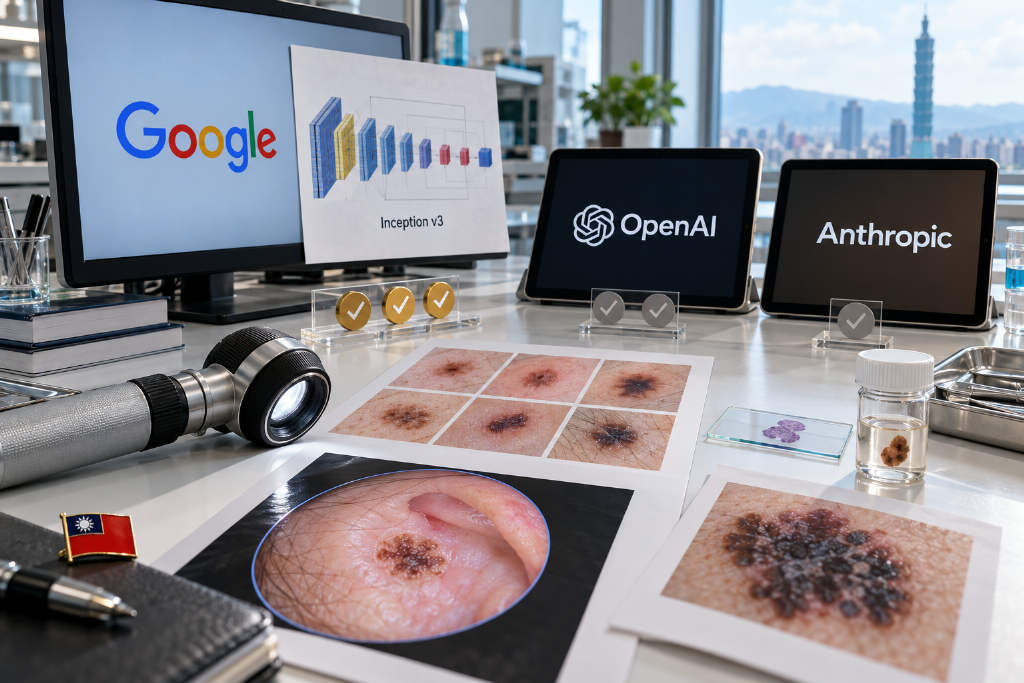
Old CNN model outperforms GPT-6 Astra and Claude Fable 5.1 in skin lesion diagnosis test

A comparison released by Lynch Lab on Oct. 25 Taipei time found that a decade-old convolutional neural network, Inception v3, beat two frontier large language models in a controlled skin lesion diagnosis task. In a set of 200 pathology-confirmed lesions, the fine-tuned CNN achieved 125 correct first-choice diagnoses out of 200, or 62%, while GPT-6 Astra and Claude Fable 5.1 produced 84 and 85 correct first-choice answers, roughly 42% each. The test used cases drawn from the public MILK10k dataset released in 2025, with each case including both a clinical close-up image and a dermoscopic image. The author, Dr. Magnus Lynch of Guy’s Hospital and King’s College London, framed the result narrowly. The benchmark measured whether each system could make the right first pick in a six-way classification task. It was not presented as evidence that any model could replace outpatient care. The article also listed several limits, including the small sample size, the fact that all cases were biopsy-confirmed and therefore relatively difficult, and the possibility that public data may have been seen by large models. The write-up argued that the result is better read as a reminder that general-purpose models do not automatically outperform specialized systems.

220
Old CNN model outperforms GPT-6 Astra and Claude Fable 5.1 in skin lesion diagnosis test
Will Semiconductor
1 months agoNews Editor

Will Semiconductor’s profit drops nearly 40% in H1 as new businesses remain too small to offset core weakness

Will Semiconductor reported a sharp slowdown in earnings for the first half of 2026, even as revenue stayed almost flat. The company posted revenue of 14.02 billion yuan, up 0.49% year over year, while net profit attributable to shareholders fell 39.85% to 1.22 billion yuan. Net cash from operating activities dropped 78.40% to 408 million yuan, and inventory rose to 9.187 billion yuan, highlighting pressure on both cash generation and working capital. The company’s core image sensor business came under strain in two of its largest end markets at the same time. Revenue from image sensor solutions fell 10.55% to 9.254 billion yuan, with automotive revenue down 16.64% and consumer electronics revenue down 30.98%. At the same time, a higher contribution from lower-margin semiconductor distribution, along with increased R&D and finance costs, weighed on profitability. Will Semiconductor is now putting more emphasis on medical imaging, AI glasses, machine vision, sports cameras and automotive analog chips as a second growth engine. Those businesses are growing, but their revenue contribution remains limited. According to the report, their combined scale is still below 2.5 billion yuan and accounts for less than 18% of total revenue, leaving the company heavily reliant on its traditional image sensor operations.

1430
Will Semiconductor’s profit drops nearly 40% in H1 as new businesses remain too small to offset core weakness